Research summary
UBT251 phase 2 in China: Cell Metabolism trial map (not a retatrutide comparison)
Editorial summary of the UBT251 triple-agonist phase 2 paper (DOI 10.1016/j.cmet.2026.09.021, NCT07177469): design, LS mean weight change at 24 weeks, limits, and why social cross-trial numbers mislead.
Published November 6, 2026· By Kris Chase / CT632 editorial
Editorial status (November 6, 2026): Peer-reviewed phase 2 human data in China only at 24 weeks. Not FDA-approved medicine, not dosing guidance, not vendor information, and not a conclusion that UBT251 “beats” retatrutide or any other product.
Instagram graphics and other social posts are a discovery lead, not a scientific source. CT632 maps the primary paper so readers can read originals before sharing numbers.
UBT251 is a triple GLP-1 / GIP / glucagon receptor agonist distinct from CT-G32 (SCO-940) (preclinical sponsor disclosures on CT632) and distinct from retatrutide (U.S./global Lilly development). The domain ubt251.com is registered elsewhere; CT632 recommends one article on ct632.com, not buying parallel domains.
Nothing here is medical advice or encouragement to use non-trial products.
Official primary source
The trial CT632 summarizes is published in Cell Metabolism:
- Title: UBT251, a novel triple GLP-1, GIP, and glucagon receptor agonist, in adults with overweight or obesity: A multicenter, randomized phase 2 trial
- DOI: 10.1016/j.cmet.2026.09.021 (verified on Cell Press / ScienceDirect landing pages during this editorial pass)
- Registries: NCT07177469, CTR20250288
Trial design (from the paper)
- Setting: 25 centers in China (March–November 2025 in the published methods).
- Population: 205 adults randomized who received at least one dose; 59.0% women; ages 18–61 in the summary (eligibility up to 75 with Chinese overweight/obesity criteria); type 2 diabetes excluded.
- Design: Multicenter, randomized, double-blind, placebo-controlled parallel groups. No active comparator to another obesity drug.
- Randomization: 2:1:1:2:2 to once-weekly UBT251 2 mg (n=51), 4 mg with initial 0.5 mg (n=25), 4 mg with initial 1 mg (n=25), 6 mg (n=54), or placebo (n=50). The two 4 mg arms share a maintenance dose but differ in starting dose / titration, with small per-arm sample sizes.
- Primary efficacy endpoint: Least-squares (LS) mean percent change in body weight from baseline at week 24 (24-week data only in this paper’s primary analysis window).
CT632 does not treat the largest LS mean in any arm as “every participant lost that much.” Response distributions and categorical thresholds are in the paper’s tables and figures.
Published LS means at week 24 (primary endpoint)
Values below are group LS means (95% CI) for percent body weight change, transcribed from the paper’s Table 2 narrative (DOI 10.1016/j.cmet.2026.09.021):
| Arm | n randomized | LS mean % change | 95% CI |
|---|---|---|---|
| Placebo | 50 | −2.0 | −3.8 to −0.2 |
| UBT251 2 mg | 51 | −13.6 | −15.3 to −11.8 |
| UBT251 4 mg (initial 0.5 mg) | 25 | −16.2 | −18.7 to −13.6 |
| UBT251 4 mg (initial 1 mg) | 25 | −19.7 | −22.2 to −17.2 |
| UBT251 6 mg | 54 | −18.7 | −20.4 to −16.9 |
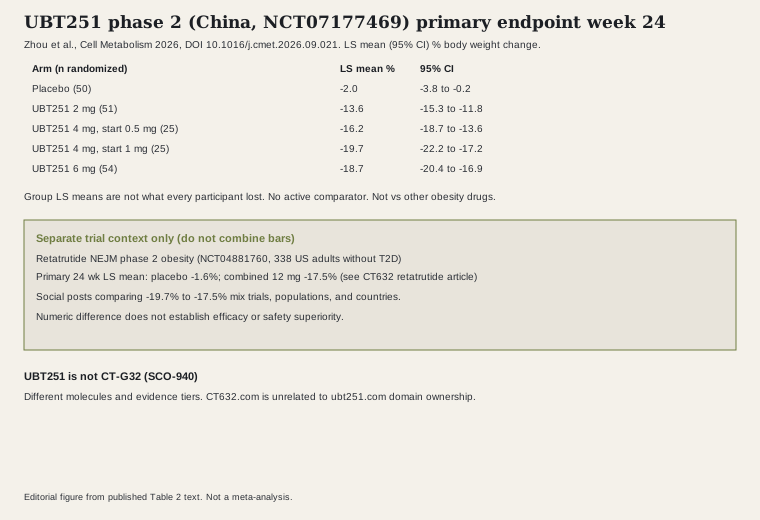
Dose-pattern caution (from authors): The 6 mg arm’s LS mean (−18.7%) was numerically smaller than the 4 mg / 1 mg start arm (−19.7%) even though maintenance dose differs. The paper states this pattern is not a simple monotonic dose–response and that exploratory arm differences may reflect chance, titration exposure, or small n — not a formal head-to-head dose comparison unless the trial prespecified one.
Placebo-adjusted LS differences in the abstract range from −11.5% (95% CI −14.1 to −9.0) to −17.7% (95% CI −20.8 to −14.6), all p < 0.001 vs placebo — still not comparisons to retatrutide or CT-G32.
Why “19.7% vs 17.5%” headlines mislead
Some posts (including reposted Instagram infographics) juxtapose:
- −19.7% — UBT251 4 mg (1 mg start) LS mean at 24 weeks in 205 Chinese adults without T2D (Cell Metabolism), with no active control drug.
- −17.5% — Retatrutide combined 12 mg LS mean at 24 weeks ( primary endpoint) in 338 U.S. adults without diabetes (NEJM, NCT04881760; CT632 retatrutide tables).
Those numbers come from separate protocols, countries, sample sizes, and estimands. Putting them side by side does not establish superiority, non-inferiority, or safer use. CT632 does not claim UBT251 beats retatrutide.
Generalizability and follow-up
- China-only centers and Chinese BMI entry criteria limit direct extrapolation to other countries’ labels and practice.
- 24-week follow-up in this paper is short for chronic weight management; longer safety (for example thyroid, pancreas, gallbladder signals in incretin-class drugs) requires longer studies.
- The paper authors write that findings support phase 3 evaluation; CT632 does not cite news forecasts for global trial readouts unless they appear in the same official registry or paper you are reading. Check NCT07177469 for current status.
Safety language (narrow)
The paper reports gastrointestinal adverse events as the most frequent events, described as mild to moderate in the summary — for this 24-week phase 2 dataset only. CT632 will not broaden that into “UBT251 is safe for everyone” or substitute for a full label-style review.
How this fits CT632’s other research pages
| Topic | UBT251 (this page) | Retatrutide | CT-G32 / SCO-940 |
|---|---|---|---|
| Evidence tier | Peer-reviewed phase 2 human (China) | Peer-reviewed phase 2 human (NEJM obesity) | Sponsor preclinical disclosures |
| Endpoint emphasis | 24 wk weight % (primary) | 24 wk primary, 48 wk secondary | Rat / in vitro (no human efficacy) |
| CT632 stance | Map paper; no product pitch | Map NEJM; FDA alert on unapproved use | Map sponsor limits |
PeptIQ’s retatrutide explainer covers class mechanism for readers already tracking approved or investigational medicines with clinicians — not a ranking of UBT251 vs retatrutide.
Reader checklist
- Open the DOI and read Table 2 before reposting a graphic.
- Note n=25 in each 4 mg titration arm — wide CIs, cautious dose interpretations.
- Do not merge UBT251 arms with retatrutide arms in one chart as if one trial.
- Separate UBT251, retatrutide, and CT-G32 by molecule and evidence tier.
- For medical decisions, use licensed care where you live — not phase 2 LS means from another country.
Bottom line
UBT251’s published phase 2 paper reports placebo-controlled weight loss LS means at 24 weeks in Chinese adults without type 2 diabetes, with registries NCT07177469 / CTR20250288. That is not proof of global approval, not a vendor guide, and not a head-to-head win over retatrutide or any other drug. CT632 hosts this explainer on ct632.com so the primary study stays readable without registering another domain.
References
- UBT251, a novel triple GLP-1, GIP, and glucagon receptor agonist, in adults with overweight or obesity: A multicenter, randomized phase 2 trial. Zhou Z, Cheng Z, Jin P, et al.. Cell Metabolism. 2026. DOI 10.1016/j.cmet.2026.09.021
- ClinicalTrials.gov record NCT07177469. National Library of Medicine. 2026. Source link
- China Drug Trials Registry CTR20250288. China Drug Trials. 2026. Source link
- Triple–Hormone-Receptor Agonist Retatrutide for Obesity — A Phase 2 Trial. Jastreboff AM, Kaplan LM, Frias JP, et al.. N Engl J Med. 2023. DOI 10.1056/NEJMoa2301972