Research summary
Retatrutide phase 2 obesity trial: published human data and regulatory context
Summary of the NEJM phase 2 retatrutide trial (LY3437943, NCT04881760): eligibility, endpoints, weight outcomes, separate diabetes trial, and FDA-sourced status notes.
Published November 5, 2026 · Updated November 6, 2026· By Kris Chase / CT632 editorial
Retatrutide (LY3437943) is a triple receptor agonist (GIP, GLP-1, and glucagon) in clinical development by Eli Lilly. The landmark obesity dataset CT632 summarizes here is the phase 2 trial in the New England Journal of Medicine (DOI 10.1056/NEJMoa2301972, PubMed 37366315), registered as NCT04881760.
U.S. regulatory status: FDA’s alert on unapproved GLP-1 products used for weight loss states that retatrutide has not been found safe and effective for any condition and cannot be used in compounding under federal law (FDA GLP-1 alert). Retatrutide has no FDA-approved drug label. That is not legal advice; it means you should treat retatrutide as a development-stage drug, not a labeled medicine.
Nothing here is medical advice, prescribing guidance, or encouragement to use non-trial retatrutide products.
Trial skeleton (obesity phase 2, NCT04881760)

The NEJM report is a randomized, double-blind, placebo-controlled phase 2 study in adults who met obesity/overweight entry criteria without diabetes:
- BMI ≥30, or BMI 27 to <30 with at least one weight-related comorbidity (hypertension, dyslipidemia, or cardiovascular disease per trial registration).
- Type 1 and type 2 diabetes were excluded (NCT04881760 exclusion criteria).
Participants were randomized to weekly subcutaneous retatrutide at several dose-escalation regimens or placebo for 48 weeks, with lifestyle counseling consistent with obesity pharmacotherapy trials. The trial enrolled 338 adults. The primary endpoint was percent change in body weight from baseline to 24 weeks; 48-week weight change was a secondary endpoint (along with categorical weight-loss thresholds such as ≥5%, ≥10%, and ≥15%). Safety follow-up included incretin-class gastrointestinal events and protocol-driven cardiac monitoring.
Funding and authorship include Eli Lilly and Company investigators and employees, disclosed in the paper.
| Topic | Obesity phase 2 (NEJM / NCT04881760) | Separate diabetes phase 2 (Lancet, PMID 37385280) |
|---|---|---|
| Population | Adults with obesity/overweight without T1D/T2D | Adults with type 2 diabetes |
| Weight endpoints | Primary: LS mean % change at 24 weeks; secondary: LS mean % change at 48 weeks | Glycemic and weight endpoints under a diabetes protocol |
| CT632 use | Cite tables below for obesity trial LS means | Cite for diabetes-specific claims only |
PeptIQ maintains a retatrutide profile with registry counts and links to NEJM/Lancet entries for readers who want a compound-centric index.
Published least-squares mean weight change (obesity cohort)
Source: Jastreboff et al., N Engl J Med 2023 (DOI 10.1056/NEJMoa2301972, PubMed 37366315, NCT04881760). Values are least-squares (LS) mean percent change in body weight in the 338 enrolled adults under trial titration schedules. Combined dose labels match the NEJM dose-escalation groups (not separate marketed products).
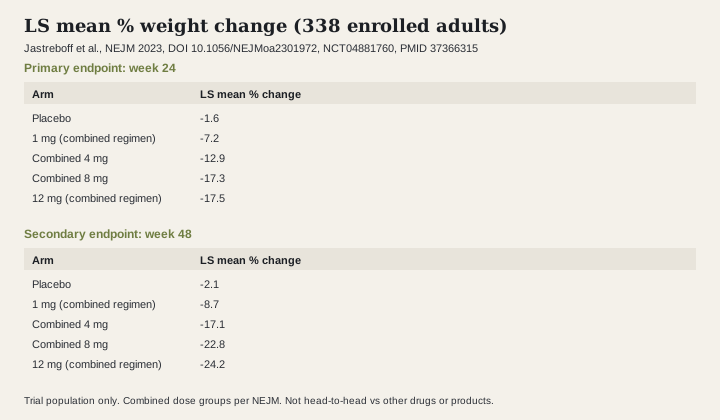
Primary endpoint — week 24
| Arm | LS mean % change from baseline |
|---|---|
| Placebo | −1.6 |
| 1 mg (combined regimen) | −7.2 |
| Combined 4 mg | −12.9 |
| Combined 8 mg | −17.3 |
| 12 mg (combined regimen) | −17.5 |
Secondary endpoint — week 48
| Arm | LS mean % change from baseline |
|---|---|
| Placebo | −2.1 |
| 1 mg (combined regimen) | −8.7 |
| Combined 4 mg | −17.1 |
| Combined 8 mg | −22.8 |
| 12 mg (combined regimen) | −24.2 |
These numbers describe trial participants and prespecified weeks only. They are not dosing instructions, not extrapolated beyond the enrolled population, and not a head-to-head comparison with other obesity medicines. CT632 does not translate milligram arms into personal use.
Interpretation rules CT632 uses for this paper:
- Treat 24-week LS means as the primary weight endpoint; 48-week LS means as secondary.
- Compare active arms to placebo at each week; read Methods for estimands, missing data, and combined dose definitions.
- Do not import obesity-trial percentages into diabetes care decisions; read the Lancet diabetes trial separately (PubMed 37385280).
- Phase 2 establishes feasibility and signal; labeling decisions require phase 3 programs and FDA review.
Mechanism in plain language
Retatrutide activates three metabolic hormone receptors where approved single- or dual-agonists already exist. GLP-1 agonism reduces appetite and slows gastric emptying; GIP co-agonism modulates insulin dynamics; glucagon receptor activity contributes to energy expenditure narratives in development materials. PeptIQ’s triple agonist explainer covers receptor biology for learners; CT632 focuses on trial architecture.
Mechanism papers do not replace outcome trials. They explain why Lilly pursued a triple molecule, not why an individual should use one.
Safety and supply boundaries
Published trials report dose-dependent GI adverse events and protocol exclusions (for example personal or family history of medullary thyroid carcinoma or MEN2, consistent with incretin-class norms). Pancreatitis and gallbladder signals remain class concerns monitored in longer programs.
Trial material ≠ compounded or “research” vials. Unapproved peptide products may differ in identity, concentration, sterility, and storage. FDA’s GLP-1 alert documents risks with unapproved GLP-1-related products, explicitly naming retatrutide among drugs not eligible for compounding (FDA GLP-1 alert). CT632 will not help readers locate sellers.
If you need pharmacotherapy for obesity or diabetes today, the actionable path is licensed clinician evaluation using FDA-approved medicines with current prescribing information—not investigational sequences from a phase 2 paper.
Phase 3 and registry follow-up
Registrational trials (TRIUMPH and related programs) extend follow-up and harder outcomes. CT632 does not treat conference slides or press releases as equivalent to peer-reviewed papers. Check ClinicalTrials.gov for NCT identifiers, status, and posted results before citing interim claims.
How CT632 and PeptIQ complement each other
CT632 explains what the NEJM obesity phase 2 paper enrolled, measured, and reported. PeptIQ.io helps people who already work with clinicians log what was agreed in care plans—dates, effects, and context—not doses inferred from trials. PeptIQ AI inside the app organizes questions about your log; it is not a replacement for medical care.
Reader checklist
- Confirm you are reading Jastreboff et al., NEJM 2023 (DOI above), not a secondary infographic.
- Verify eligibility: obesity/overweight cohort without diabetes (NCT04881760).
- Separate NCT04881760 from the type 2 diabetes phase 2 paper (PMID 37385280).
- Treat non-prescription retatrutide as unknown quality, not trial-equivalent material.
- Compare treatment decisions with your clinician to approved labels (for example semaglutide or tirzepatide), not phase 2 arms.
Bottom line
The NEJM phase 2 obesity trial is peer-reviewed human evidence for retatrutide’s weight-related effects in the enrolled population under protocol conditions. It is not an FDA approval, and FDA’s public materials state that retatrutide has not been found safe and effective for any condition and cannot be used in compounding under federal law. Read both primary trials on their own terms, and use PeptIQ only for structured tracking alongside professional medical care.
References
- Triple–Hormone-Receptor Agonist Retatrutide for Obesity — A Phase 2 Trial. Jastreboff AM, Kaplan LM, Frias JP, et al.. N Engl J Med. 2023. DOI 10.1056/NEJMoa2301972
- Retatrutide, a GIP, GLP-1 and glucagon receptor agonist, for people with type 2 diabetes: a randomised, double-blind, placebo and active-controlled, parallel-group, phase 2 trial conducted in the USA. Rosenstock J, Frias J, Jastreboff AM, et al.. Lancet. 2023. PubMed 37385280
- FDA’s Concerns with Unapproved GLP-1 Drugs Used for Weight Loss. U.S. Food and Drug Administration. 2026. Source link