Research summary
CT-G32 (SCO-940): four-receptor preclinical data and sponsor disclosures
Editorial map of Scohia/Celltrion CT-G32 (SCO-940) TIDES Europe 2026 disclosures: four-receptor concept, rat preclinical comparisons, evidence limits vs human retatrutide trials.
Published November 6, 2026· By Kris Chase / CT632 editorial
Editorial status (November 6, 2026): Preclinical evidence — not proven in humans. CT632 is a reading room name and is not the same molecule, program, or brand as CT-G32 or SCO-940 (names that can look similar in print).
Recent discussion in peptide research circles (for example Peptide Universe on X, November 2026) highlighted CT-G32 / SCO-940 as a distinct early-stage program. This page summarizes what sponsors and press reported at TIDES Europe — not independently reproduced lab work by CT632.
Nothing here is medical advice, investment guidance, or encouragement to use unapproved products.
What sponsors said CT-G32 is
According to Scohia’s 4 November 2026 English release (Scohia TIDES Europe news), SCO-940 (CT-G32) is described as a single-molecule agonist targeting GLP-1, GIP, glucagon, and amylin receptors, developed under co-development with Celltrion. The release reports in vitro receptor activity and diet-induced obese (DIO) rat studies presented at TIDES Europe.
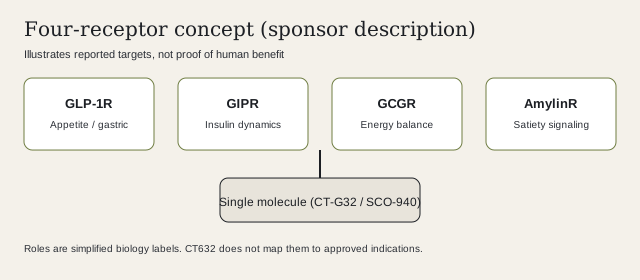
Receptor roles in the schematic are cautious biology labels (how incretin-class drugs are often discussed), not claims that CT-G32 delivers those effects in people.
What was — and was not — disclosed publicly
Scohia’s release and Korean business press coverage (Herald Economy, 2026) attribute several qualitative findings to the sponsor presentation. CT632 lists them as attributed claims with dates, not as facts we verified in primary data files:
| Sponsor-attributed topic (Nov 2026 disclosures) | Public detail level |
|---|---|
| Weight change in DIO rats at the same molar dose vs retatrutide | Described as numerically greater weight loss for CT-G32; no public percentage, sample size, uncertainty, protocol, or significance values in the release |
| Lean body mass (LBM) during weight reduction | Smaller proportion of weight lost as LBM vs retatrutide in the same animal comparison; LBM includes muscle, bone, and other non-fat tissue — not the same as established “muscle-sparing” in humans |
| Hyperinsulinemia | Reported improvement in the animal model (sponsor) |
| Non-human primate pharmacokinetics | Prolonged exposure; potential weekly formulation discussed — not an established human dosing interval |
| Development timeline | Celltrion plans cited: IND filing February 2027, first human dosing targeted Q2 2027 (sponsor/press); no human efficacy or safety data located by CT632 as of 5 November 2026 |
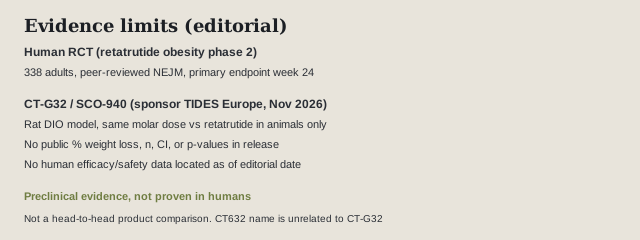
CT632 will not chart invented percentages, imply CT-G32 “beats” retatrutide clinically, or treat rat same-molar comparisons as predictive of human outcomes.
Why this is not comparable to the NEJM retatrutide obesity trial
Human evidence for retatrutide in obesity without diabetes comes from a peer-reviewed phase 2 randomized trial (PubMed 37366315, NCT04881760): 338 enrolled adults, prespecified primary weight endpoint at 24 weeks and secondary endpoint at 48 weeks, with published least-squares mean percent changes (CT632 retatrutide summary).
CT-G32 disclosures, by contrast, are preclinical, different species, and sponsor-reported at a conference without the numeric transparency of the NEJM paper. Comparing them for clinical efficacy is invalid. CT632 does not rank products for prescribing or purchasing.
For mechanism and trial context on the approved-development triple agonist already in human trials, see PeptIQ’s What is retatrutide? and our retatrutide phase 2 article.
Regulatory and naming boundaries
- CT-G32 / SCO-940 is not an FDA-approved drug as of this editorial date; sponsor materials describe planned IND and first-in-human timing, not completed U.S. approval.
- Retatrutide remains investigational for U.S. labeling; FDA’s public alert states it has not been found safe and effective for any condition and cannot be used in compounding under federal law (FDA GLP-1 alert).
- CT632 does not sell peptides, rank vendors, or imply a business relationship between ct632.com and CT-G32.
Reader checklist
- Read the Scohia primary release (URL above) before secondary social posts.
- Separate rat preclinical sponsor slides from human RCT papers.
- Do not treat “numerically greater” animal weight loss as a clinical win without disclosed effect sizes and human data.
- Use retatrutide trial LS means only for NCT04881760, not for CT-G32.
- Track your own care plans with a clinician and approved medicines; PeptIQ tools are for structured logging, not replacing medical decisions.
Bottom line
CT-G32 (SCO-940) is an early, sponsor-described four-receptor program with preclinical data and planned human study start dates — not proof of benefit in people, and not interchangeable with retatrutide’s published human trial. CT632 documents that gap so readers can place conference headlines in context.
References
- Scohia Pharma announces presentation of SCO-940 (CT-G32) at TIDES Europe. Scohia Pharma Co., Ltd.. 2026. Source link
- Celltrion, Scohia obesity drug shows promise in animal tests (Herald Economy reporting). Herald Corporation. 2026. Source link
- Triple–Hormone-Receptor Agonist Retatrutide for Obesity — A Phase 2 Trial. Jastreboff AM, Kaplan LM, Frias JP, et al.. N Engl J Med. 2023. DOI 10.1056/NEJMoa2301972
- ClinicalTrials.gov record NCT04881760. National Library of Medicine. 2023. Source link