Listicle
Seven research questions to ask before you trust a peptide study claim
A checklist for judging peptide papers and trial posts: species, registration, endpoints, compound identity, conflicts, and what counts as human evidence.
Published November 5, 2026· By Kris Chase / CT632 editorial
Social feeds turn a single PubMed link into a product verdict. CT632 is built to slow that down. Before you share, buy, or track anything based on a peptide “study,” run the claim through these seven questions. They are adapted from standard reporting guidelines (CONSORT for randomized trials, ARRIVE for animal work) without pretending CT632 is a peer-reviewed journal itself.
1. Was this study done in humans, animals, or cells?
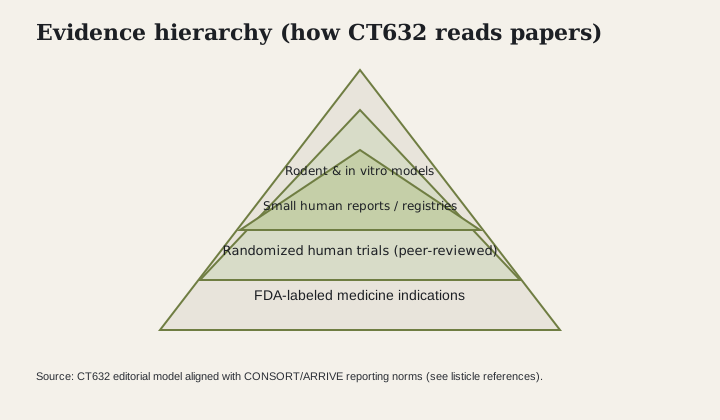
A rodent tendon-healing experiment can be excellent science and still irrelevant to your outpatient decision. Label the tier explicitly:
- In vitro — mechanism only.
- In vivo animal — translation uncertain.
- Human observational — hypothesis-generating.
- Human randomized trial — strongest for causal claims, still needs scrutiny.
If a influencer skips the species line, stop reading until you find it in the methods.
2. Is the compound the same molecule you can name on a label?
Peptide names collide: TB-500 vs thymosin beta-4 fragment, BPC-157 vs “body protection compound” blends, retatrutide vs semaglutide mislabels in seized vials. Match sequence, salt form, route, and formulation between the paper and the product claim. Analytical papers that identify research peptides by mass spectrometry are about identity, not approval.
PeptIQ’s plain-language primer separates FDA-approved peptides from research chemicals; CT632 applies that lens to citations.
3. Is there a trial registration with matching endpoints?
For human interventional studies, find an NCT (or equivalent) entry before results exist. Check:
- registered primary outcome vs published primary outcome;
- status (completed, terminated, recruiting);
- posted results on ClinicalTrials.gov.
A preregistered trial that never finished is not hidden efficacy; it is missing data.
4. What was the primary endpoint, and was it clinically meaningful?
Biomarkers and histology scores matter for science. They are not always patient-centered outcomes. Ask:
- Did the trial measure what patients feel or functionally need?
- How large was the effect vs placebo at the prespecified time?
- Who dropped out, and how were they analyzed?
Secondary endpoints and subgroup plots are exploratory unless pre-specified.
5. How large and representative was the sample?
Phase 1 safety cohorts, n=12 case series, and mega-trials live on the same PubMed index but not the same evidence ladder. Small studies can be valid; they cannot support population-wide claims. Weight the uncertainty explicitly instead of saying “science shows.”
6. Who paid for it, and what relationships are disclosed?
Industry-sponsored drug development is legitimate and common. It is still a reason to read methods closely and wait for independent replication. Look for:
- manufacturer authors;
- investigator grants from sellers;
- patents on the peptide;
- affiliate blogs citing only their SKU.
CT632 is editorially operated by PeptIQ LLC. We disclose that relationship on our about page and link out to PeptIQ for product education — not because those links substitute for primary papers.
7. Does the claim match regulatory status where you live?
Research-only peptides, compounded copies of approved drugs, and fully labeled medicines can all appear in the same thread. A paper on investigational retatrutide does not make compounded vials lawful or equivalent. An FDA-approved GLP-1 requires a prescription and labeled risk management — a different branch entirely.
PeptIQ’s evidence-by-goal map scores compounds on human evidence and regulatory posture without vendor lists; use it after you answer question seven for yourself with a clinician.
How to use this listicle in practice
Print it mentally when you open CT632 research summaries, PeptIQ profiles, or primary PDFs. If a claim fails two or more questions, file it under interesting, unproven — not under protocol.
Tracking what you read and what you and your clinician decide belongs in tools like PeptIQ.io; understanding what the literature actually tested belongs here.
Bottom line
Good decisions start with boring metadata: species, molecule, registration, endpoint, sample, money, and law. CT632 will keep publishing source-grounded articles that show the work; this checklist is the compact version you can reuse on every new paper.
References
- CONSORT 2010 Statement: updated guidelines for reporting parallel group randomised trials. Schulz KF, Altman DG, Moher D, et al.. BMJ. 2010. DOI 10.1136/bmj.c332
- Animal research: reporting in vivo experiments: the ARRIVE guidelines. Kilkenny C, Browne WJ, Cuthill IC, et al.. PLoS Biol. 2010. PubMed 20613859